Most change-management frameworks describe what should happen.
This is the mechanic — what actually happens when you run the change yourself, three times, across three waves, from inside the work rather than outside it.
When change starts
Intuition first — gut feeling. The decision follows.
Operators don’t analyze their way to “now is the time.” They feel the cost of not changing become heavier than the cost of changing. Multiple signals start pressing the same direction — customers, peers, market, leadership above, attrition inside the team. Pain moves from background to foreground.
Below that threshold: you tolerate. At it: you run the playbook.
Pre-conditions
Two things must be true before the playbook is worth starting.
Net benefit visible. Either you can see it, or the relevant stakeholders see it after a conversation. If nobody can see it, you are not ready to lead the change — you are ready to do the diagnostic that surfaces it.
Buy-in or full ownership. Either the people whose context you are affecting have signaled support, or you own that context completely. Without one of the two, you do not have the surface to act.
Authority, influence, coalition
This is the part most frameworks oversimplify. The shape varies per run.
- Sponsor and operator can be the same person, or split. Sometimes you hold both; sometimes a sponsor above you holds authority and you operate with influence.
- Authority can be yours, borrowed from a sponsor, or paired with someone else’s. Borrowed authority works — when stakes are high, the sponsor’s air-cover is what keeps the operator credible.
- Influence-only is viable when you have a credible sponsor. Authority-only is viable when the stakes are low enough that backlash is tolerable.
- Coalition is conditional, not default. Build it when you do not own the context — cross-functional alignment with whoever does. Skip it when you own the context. Coalition is the tool that compensates for missing ownership.
The playbook, mapped to the adoption curve
Operator actions do not sequence as discrete checkboxes. They layer onto each other, timed to where the team sits on Rogers’ diffusion-of-innovations curve.
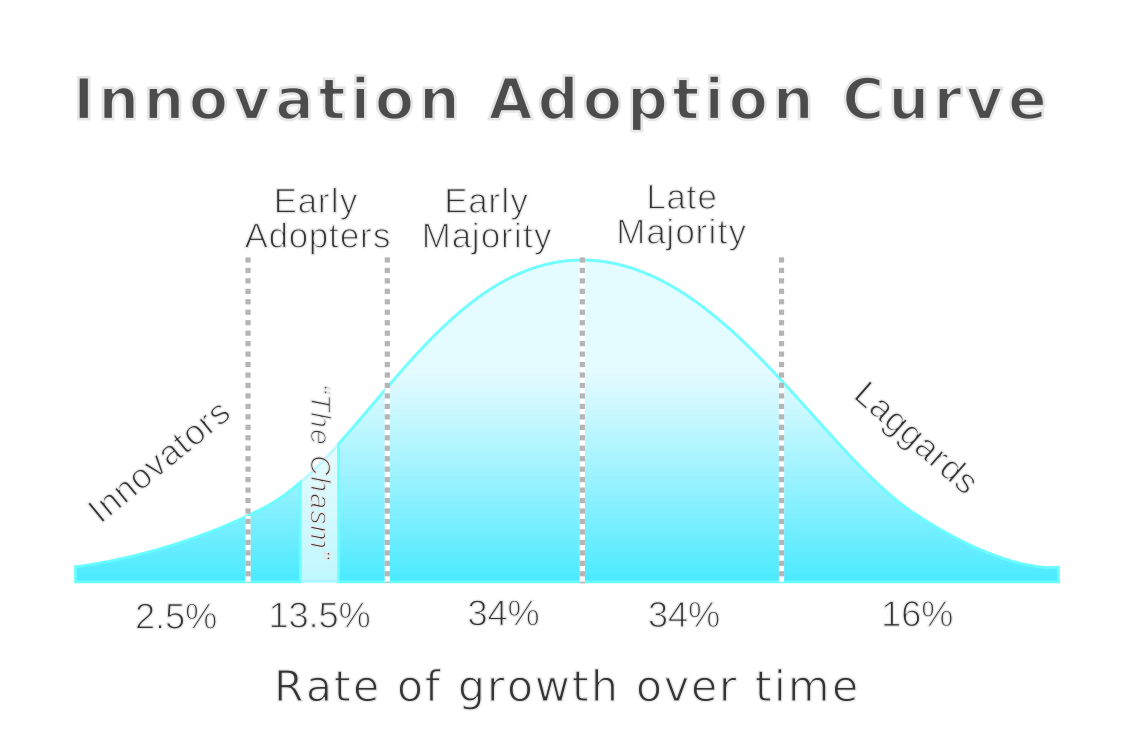
Diagram: “Innovation Adoption Curve” by Jim McKeeth, CC BY-SA 4.0, via Wikimedia Commons.

| Adoption stage | What you do | What you do NOT do yet |
|---|---|---|
| Innovators (~2.5% — you) | Lead the way. Earn fluency before introducing. | Talk about it broadly. |
| Early Adopters (~13.5%) | Find champions. Enable them. Build momentum quietly. | Add governance. Set KPIs. |
| Chasm crossing | First governance layer. Early KPIs (observe-only). Mentor adopters asking for coaching. | Accelerate. Formalize. |
| Early Majority (~34%) | Mature the governance. Mature the KPIs. Start formalizing process. | Set objectives. |
| Late Majority (~34%) | Formalize fully — KPIs, objectives, the new bar. Mentor remaining resistance. | Tolerate misalignment. |
| Laggards (~16%) | Handle the final misalignment — re-role, performance plan after deep mentoring, or part ways. | Punish broadly. |
The right column matters as much as the left. What you do not do yet is what protects the early-stage signal from premature pressure. Most rollouts fail by adding governance, KPIs, or formal objectives too early — before the champions have produced the proof that earns them the right to govern.
The five crossings
1. From idea to Innovator — you lead.
You adopt first, hands-on, on real work — not in a sandbox. Personal fluency is the credentialing step. The team will not trust the rollout if you are operating from briefings. This phase has one output: you earn the right to introduce.
2. Innovator to Early Adopters — find the champions.
They are already in the team. Identify them, enable them, pair them with each other. Do not announce the change yet. Champions deliver; their work shows up in the team’s rhythms — meetings, planning, reviews. Adjacent team members start asking on their own. Talking too early hardens positions before the proof lands.
The closest crystallization of this discipline lives in Change Injection: Shaping Systems Without Collapse — specifically the “Quiet → Visible → Absorbed” sequence.
3. Crossing the chasm — let it bake.
Late Early Adopters start applying pressure — “why aren’t we all using this?” That is the signal that momentum is real. Resist accelerating. Three things land here:
- First governance layer — codified rules, guardrails, the structural constraints that prevent quality drift as more people adopt.
- Early KPIs as observation only — leading and lagging indicators, input and output, tracked per project and per person. Do not yet attach incentives.
- Mentoring for those asking to be coached — not for resisters yet; for adopters who want help getting fluent faster.
4. Early Majority crosses — formalize what works.
The center of the curve absorbs. Mature the governance. Mature the KPIs. Start formalizing process. Champion habits become team conventions. Reviews enforce the new bar without long debates.
5. Late Majority and Laggards — formalize fully and handle resistance.
The remaining pragmatists adopt because the new way is now the path of least resistance. Bonuses, OKRs, the promo bar — attached. Objectives set. The new bar is the standard.
The final laggards reveal themselves here. This is where resistance handling matters most.
Resistance — all of it is misaligned incentive
Resistance is not a personality trait. It is incentive structure showing through. Sometimes the incentive can be re-aligned. Sometimes it cannot. The handling follows the root cause.
| Pattern | What is misaligned | Can re-align? | Handling |
|---|---|---|---|
| Hider (capability gap) | The floor rose faster than the person’s skill | Usually yes | Private mentoring, paired sessions, clear expectations, sustained coaching |
| Purist (correct prior judgment) | Identity around the old bar; principled non-adopter | Usually yes — time and evidence | Zero pressure. Continued access, continued visibility into champions’ work. They arrive on their own. |
| Saboteur (power loss) | Held power in the old system; loses it in the new | Usually no — the misalignment IS the power loss | Authority intervention from the sponsor. Re-role inside the org, or part ways. |
The hider pattern shows up most often. Two months of deep mentoring before performance management starts — that is the order. The reverse poisons the rollout for everyone else.
The purist pattern resolves on its own, given time and evidence. The mistake is pushing.
The saboteur pattern is where authority intervention matters. The misalignment runs through identity and power, not skill. Sponsor-level handling, not operator-level coaching.
The broader operating discipline for running these patterns in parallel — coaching one set up, holding space for another set to come around — is the principle in Influence-First Cross-Functional Leadership.
The end-state — the bar locks itself
When the playbook works, the new bar self-maintains — not because culture has shifted, but because incentives now align toward keeping the new state. Objectives, bonuses, promo criteria, peer norms, governance enforcement — all point the same direction. Regressing back to the old way would require fighting what the system has become.
Lewin’s classical “refreeze” is the closest concept, but the mechanism is different — Lewin treats it as cultural absorption. In practice it is incentive geometry.
Three runs from the field
The playbook above did not emerge in the abstract. It comes from three runs across three different waves, three sponsor configurations, and three surfaces. Each run held the same shape.
Run 1 — Statistical-framework rollout in a product-growth team. Cross-functional mandate; not my team. Two consecutive quarters of A/B experiments had produced no measurable lift on product-growth KPIs. Internal confidence had eroded. Management was questioning whether the function was viable at all. A CEO mandate sponsored the rebuild; I ran it with influence; one champion inside the growth team carried it day-to-day, with no growth head in place at the time. The change: statistical rigor — sample size, false positive and false negative rates, statistical power, guardrails (the KPIs that should not move), leading and lagging indicators, and a holdout group to measure against a no-experiment baseline. The saboteur pattern emerged here — a person whose gatekeeping role over what counted as a “valid” experiment was reduced by the new framework. Sponsor intervention handled it; the person was re-roled. Outcome: shared language across the team, recovered trust from management, better causal reasoning, disciplined abandonment of experiments that were never going to validate.
Run 2 — Engineering practice elevation after an in-housing transition. A different wave under a CTO mandate. Survival speed during the in-housing migration — vendor lock-in handcuffs, ship-first, tolerated hacks, deferred quality bars — had to give way to production-grade engineering once the platform was on its own infrastructure. The hardening cycle documents the engineering side; this run is the people-and-practice side. I sponsored and held authority directly; senior devs as champions. The change: testing discipline, ADRs documented for both humans and agents, architectural rules, the Boy-Scout principle, stricter reviews, security discipline. The hider pattern emerged — one engineer two months into deep mentoring before performance management started. Outcome: zero security hotspots, ADRs codified, test coverage 30% → 50% → 70%, bug rate 1–2 per week to 1–2 per month, velocity up after refactor.
Run 3 — AI adoption across a live platform. A further wave under the same mandate. Documented end-to-end in Engineering AI Adoption on a Live Platform. I sponsored and held authority directly; champions among the senior engineers. Endpoint: more than 90% of new code AI-written, 2–3x velocity on most surfaces, 5–10x on greenfield work, straightforward bug-fixing, and abstraction-heavy surfaces. Both hider and purist patterns appeared; both detailed in the companion case file.
Three different surfaces — analytics inside a cross-functional team I did not manage, internal engineering practice elevation, AI tooling adoption across the platform. The same playbook held on all three.
Why operator-built matters
Frameworks built by consultants describe the shape of change from outside the work. They are useful as vocabulary.
The mechanic — what to do when the senior team member is two months into mentoring and the bar still is not holding; what to do when the saboteur escalates; when to add governance and when to wait; when to talk and when to let the work speak — lives inside the running.
This is one playbook from three runs, three waves, and three sponsor configurations. It held in each. The companion case file — Engineering AI Adoption on a Live Platform — shows it end-to-end on one surface.